
grader

Are You A One Trick Pony Or Are You Ready To Multi-Skill?

There are two basic types of heavy equipment operator – those who specialize in one type of equipment and those who multi-skill and operate a range of equipment. There is still room in the industry for both, however, employers are showing a preference for multi-skilled operators. The rationale is simple; employers can place multi-skilled operators where the need is most. This is much more preferable to having an operator idle because there is no work for them at that time.

Fortunately, there is a lot of common ground when it comes to different heavy equipment. Dirt is dirt and it doesn’t matter what sort of equipment you are using, dirt will act the same. The same can be said for any other material being used. Students can concentrate on learning the actual mechanical actions required to operate a range of equipment, then practice, practice and practice for as many hours as possible.

At ATS Heavy Equipment Operator Training Schools, we deliver training on a range of heavy equipment including:

  • Bulldozers,
  • Graders,
  • Backhoes,
  • Loaders, and
  • Excavators.

Those are the most common machines in use and the skills learned can be transferred to other types of heavy equipment. Safety training is common to all machinery types as are skills such as site plan reading and learning about the different types of dirt.

If you can graduate from a heavy equipment training program with skills in a range of equipment, you will find you are more attractive to many employers than those that have only the one skill. Being a one trick pony is fine and you will get by, however, being multi-skilled opens more doors, and give you options on the direction you want to take in the future.
Read more

How Heavy Equipment Technology Is Changing The Pace Of Construction

Mention technology these days and most people automatically think about computers. While they do have an important role to play, new heavy equipment technology involves far more. If you were to compare today’s machinery with those from twenty or more years ago, the changes, while not so obvious from the outside, are huge when you get ‘under the bonnet’.

Hydraulic systems are one area that has gone through considerable change. The hydraulics on today’s equipment are more efficient, quieter and less prone to break down compared to older equipment. The engines are now far more fuel efficient, expel far less in the way of pollutants and are quickly reaching a point of being labeled ‘environmentally friendly’. Twenty years ago, you could smell a bulldozer in operation a mile away, if you couldn’t smell it, you could often see the plume of black smoke coming out of its stack. You could most definitely hear it at work.

Computers are of course making themselves felt when it comes to heavy equipment technology. Adding GPS locators has meant that stolen equipment is now retrieved, often within hours of going missing for weeks or months. GPS is also being used to help operators complete tasks more accurately and faster than those units not using GPS.

Heavy equipment technology improves because operators are constantly looking at ways to get more work done in far less time. Construction companies are paid by the completed project, with most projects having penalties for finishing late and bonuses for early completion. Being able to complete a project means getting paid more, early, and being free to start the next project. New heavy equipment technology is helping construction companies achieve this.

Despite all these changes, the operating basics haven’t changed that much. If anything, learning to operate heavy equipment has become a lot easier. If I can operate a bulldozer then you can as well – if not a bulldozer then a grader, backhoe or excavator. Why don’t you consider a career as a heavy equipment operator – heavy equipment technology is making the task easier everyday.

Read more

Bulldozer Operators And Snow Plows

We are rapidly approaching that time of year when traffic on many of our roads stops to a crawl, or stops altogether. The cause? Snow! Bulldozer operators are often recruited to operate the snow plows used to clear roads. They are not the only operators called upon.

In some areas, trucks and/or farm tractors are fitted with a bulldozer type blades. They perform the same role as a bulldozer although not quite as effectively. Other areas use graders. These are particularly useful in areas where the snow has been compacted.

Technically speaking, a snow plow is the blade that is fitted to any vehicle. A rail car that has a blade fitted is also known as a snow plow. Rather than having heavy equipment experience, you require train driver training to operate these vehicles.

There are of course several specific purpose vehicles that have been built that also bear the name snow plow. When looking for employment as a snow plow operator, you need to clarify what type of snow plow is being used, otherwise you may find yourself operating unfamiliar vehicles with snow plow blades attached rather than specific snow plows.

Dedicated snow plows are very similar to bulldozers so a bulldozer operator will generally have a lot of the operational skills required to operate the machine. Using a grader on icy roads is very similar to using a grader on any other surface. Graders are popular since they can be set to very fine measurements shaving the road to within fractions of an inch of the sealed surface.

Looking to work as a snow plow operator? Start by undertaking a bulldozer or grader operator training program. ATS Heavy Equipment Operator Schools offer heavy equipment training programs that deliver skills in a range of heavy equipment – just what you need if you want to work as a snow plow operator.

Read more

Feel The Power Of Heavy Equipment – There Is Nothing To Compare

Heavy equipment like bulldozers, excavators and even graders are incredible machines when it comes to power. Take the bulldozer as an example. For their size, they can move an incredible amount of earth. To sit in the operators seat and feel that power in your hands and through your legs – there is nothing like it.

I am sure some would argue – truck drivers, pilots, ships captains and others and they are probably right. However, with heavy equipment, the results, the power, and the earth being pushed around is now – you can see and feel it as it happens.

Learning to operate heavy equipment is a life long task. Just when you feel you know your machine inside out, you come across a job that is different, on different terrain, or requires such precise movements. Once again you are learning what your equipment can do and what you can do.

Of course, this ongoing learning process needs a good foundation to start with. The foundations of a good heavy equipment operator can only be built through training from accredited and professional heavy equipment training schools.

ATS Heavy Equipment Operator Schools are not only accredited, they are also recognized for delivering quality training and preparing students for the workplace. If you want to feel the power of heavy equipment then contact us ATS either through our website or on 1.800.678.8120.

Read more

Specialized Heavy Equipment – Pipe Layers

Once the excavator, backhoe or trench-digger have completed their task, it is time to call in the specialized pipe laying machines. These are relatively easy to operate when it comes to controls. Most units are comprised of a swing control and raising and lowering controls. Of course, like most heavy equipment, they have a drive control for movement.

Pipe laying machines do just that. They pick up pipes are lower them into the trench as precisely as possible. This process means that long lengths of pipe can be lowered and connected fairly quickly. They can be used for hard piping such as the cement piping used for sewerage, stormwater, or mains water. They can also be used to lay softer pipes used for telecommunications such as fiber optics.

Whilst the operation of a pipe layer is fairly straight forward. Many businesses in this field prefer operators that have a history of heavy equipment operation such as a bulldozer, backhoe or excavator. There is certainly a requirement to have the safety aspects of this training before starting work. Training for a pipe layer builds on the skills already acquired and can be done on the job.

To gain skills as a heavy equipment operator, you need training from a reliable accredited training organization such as ATS Heavy Equipment Training Schools. At ATS you can be trained in the use of a variety of machines including bulldozers, graders, excavators and front end loaders. Check out the site for details on free online training, training dates and employment assistance.

Read more

History Of The Motor Grader

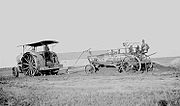
grader 1918Graders have been use for a long time in helping construction workers and engineers to build and improve communities. They are useful tools.

Graders are typically used to refine the grading that is started by heavier equipment like bulldozers and scrapers. These vehicles are used for rough grading. Dirt and gravel roads have been built using graders since 1903 when two entrepreneurs built the first Russell grader. Not long after that, commercial manufacturers like Caterpillar and John Deere began to make them for mass production. Some communities in the north use graders to scrape snow off of roads for safer travel. Even many farmers and ranchers all over the world use them to do farm work that is essential for their own maintenance needs.

The image above is a grader from 1918, borrowed from Wikipedia.

Grading is a common practice today in construction and engineering and with the help of ATS Heavy Equipment School, persons interested in learning a trade can learn to use a grader as well as other common heavy equipment.

Read more